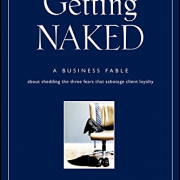
Getting Naked
A Business Fable…About Shedding the Three Fears That Sabotage Client Loyalty
By Patrick Lencioni
Another extraordinary business fable from the New York Times bestselling author Patrick Lencioni
- Offers a key resource for gaining competitive advantage in tough times
- Shows why the quality of vulnerability is so important in business
- Includes ideas for inspiring customer and client loyalty
- Written by the highly successful consultant and business writer Patrick Lencioni
This new book in the popular Lencioni series shows what it takes to gain a real and lasting competitive edge.
Recommendation
Being vulnerable takes guts, especially in business. But the payoff, explains best-selling author Patrick Lencioni, is strong, honest client relationships that engender trust and allegiance. Lencioni puts forth his “naked service” model via a story about a fictitious consultant named Jack Bauer (not to be confused with the main character on the TV show “24”). Jack, an up-and-comer at a big consulting firm, is put in charge of the newly acquired Lighthouse Partners. He’s initially reluctant to embrace Lighthouse’s nonconformist tactics, but when he opens his mind to their possibilities, he has a life-changing experience. Through Jack, you learn about the three fears that block naked service and how to master them. Instead of writing a novel, Lencioni could just have outlined the naked service model in a dozen pages and, in fact, he does so at the end of the story. However, using a business fable as a vehicle is a simple, fun, engaging and relatable way to teach his concepts.
Takeaways
- “Naked service” calls for being vulnerable and creating trusting, open relationships with clients as depicted by the fictitious story of Jack Bauer.
- When Bauer took charge of a merger between his employer, a big consulting firm, and a smaller consultancy, Lighthouse, he learned about naked service.
- Naked service requires providers to master three primary professional fears: the fear of losing business, of being embarrassed and of feeling inferior.
- Lighthouse founder Michael Casey established principles to help consultants and other professionals overcome these fears, such as focusing on helping, not on selling.
- “Ask dumb questions” and provide obvious suggestions without chagrin.
- Tell clients the truth, even when they don’t want to hear it.
- Be willing to “take a bullet” for your clients, such as accepting blame for problems you didn’t cause to remove the burden from your customers.
- Show the client that you are willing to do the hard “dirty” work.
- Strengthen your relationship with the client by being honest about your shortcomings.
- Being your authentic self, flaws and all, is the way to connect and build trust.
Summary
Uncovering “Naked Service”
Businesspeople are supposed to be confident and self-assured, so most try to project that image. They work to hide their mistakes and imperfections. However, when you let people see you for who you really are, you can make real connections and build trust. In the service industries, showing your vulnerability, or “getting naked,” is particularly effective in fostering closer client relationships. Most people resist showing vulnerability, but if you overcome this fear you will build stronger relationships, receive more referrals and spend less time haggling over fees. The following business fable illustrates the power of “getting naked”:
Once Upon a Time…
Jack Bauer was a rising star at the management consulting firm Kendrick and Black in San Francisco. As head of sales in the strategy division, he often lost competitions for new business to a small consultancy named Lighthouse. Jack was relieved when he heard that Lighthouse founder Michael Casey was leaving the firm to “spend more time with his family,” usually a euphemism for being eased out after making a big mistake. Jack’s euphoria dwindled when K&B’s founder, Jim Kendrick, told him the firm had bought Lighthouse and Jack was now in charge of the merger. Uneasy, Jack discussed his new duties with his boss, Marty Shine, who admitted that he saw Casey as “self-righteous” and “phony.” Marty viewed Lighthouse as a “country club” where no one worked nights or weekends. He said Lighthouse people wouldn’t last at K&B. “More than anything else,” Marty said, “we just have two completely different cultures.”
Getting to Know You
A few days later, Jack drove to Lighthouse’s office in a pretty coastal town to meet the staff. The office, a former school, retained some of its original charm. From the parking lot, Jack could see a blue and white lighthouse in the distance. Lighthouse partner Amy Stirling greeted Jack from the reception desk where she was filling in for the honeymooning receptionist. Michael Casey had already left the firm, but Amy introduced her fellow remaining partners, Dick Janice and Matt O’Connor. Dick, the oldest partner at 50-something, greeted Jack calmly. Matt, a young man, seemed more nervous. Jack began by detailing his background and filling them in about K&B. He didn’t say that K&B bought Lighthouse primarily to remove the competitive threat. He asked the partners how business was going. Matt explained that they were busier than ever and even had to turn away a few clients. Jack was shocked at the idea of dismissing paying business.
“Clients come to trust naked service providers because they know that they will not hold back their ideas, hide their mistakes or edit themselves in order to save face.”
As the group reviewed Lighthouse’s financials, Jack was stunned to see that it employed very few junior consultants, the cheap workforce that was the backbone of K&B. He was even more surprised that Lighthouse charged higher fees than K&B. Jack went back to K&B and reviewed his first day at Lighthouse with Marty. The following Friday, they met with Dick, Matt and Amy in K&B’s offices to explore how Lighthouse beat them in getting clients and earned higher fees. Jack began the meeting by going over K&B’s strategic techniques and models. The Lighthouse partners asked intelligent questions and presented their backgrounds. They described using methods similar to K&B’s, except that they spent much more time on-site with clients.
“Once a client trusts you and really understands that you care more about them than about yourself, they usually stop worrying about micromanaging the cost or seeing if they can take advantage of you.”
When Jack went to Lighthouse the next week, Amy wondered why he hadn’t inquired about Michael Casey. It turned out that Casey did leave to spend time with his family, but that was because his daughter and her family had been in a terrible car accident. His son-in-law died; his daughter was severely injured, and Michael and his wife were caring for their two little girls. Humbled, Jack asked Dick, Matt and Amy why Michael didn’t sell the company to them. Matt explained that by selling it to K&B, Michael had secured each partner’s financial security.
Dick’s Approach
Jack still couldn’t pinpoint exactly why Lighthouse was so successful. Then he went on a sales call with Dick. First, they went to see a client, Charlie, the marketing head of a successful Mexican restaurant chain. Greeting Dick warmly, Charlie asked him to check some new material from the chain’s marketing firm. Dick frowned at the mock-ups of stereotypical Mexican restaurant artwork. He reminded Charlie that the company had decided to get away from standard Mexican fare. Charlie replied that Mike, the owner, liked the art. Dick immediately found Mike and tactfully but firmly said, “I’m not going to pay 19 bucks for Chilean sea bass at a restaurant that looks like that.” Mike wasn’t happy, but he also wasn’t affronted by Dick’s directness. He conceded, “Neither would I.” When Jack questioned Dick’s bluntness, he quoted Michael Casey, who asked, “If we weren’t willing to tell the client the kind truth, why should they pay us?”
“Our clients have treated us more like real partners and team members than as vendors or outsiders.”
At a typical K&B sales meeting, Jack would make a presentation about the firm and explain how it could help a potential client. Dick’s approach was very different. When they met with Lighthouse’s prospect, the CEO of a transport firm, Dick asked questions and let the client talk. Soon, they were discussing a problem that was bothering the CEO. Dick continued to probe and offer suggestions. The client asked if they could continue the conversation at his firm’s staff meeting the following week. When the CEO asked about fees, Dick replied that they could figure it out after the next meeting. The prospect came on board so easily, Jack felt bewildered. He thought, “I am a salesman. Dick is just a consultant. He didn’t do any selling…he just went in there and started helping them.” Dick explained that Lighthouse began each client relationship by focusing on issues. Then the partners decided whether to take the client. When Jack asked why they would turn away clients, Dick explained they didn’t want to waste time if they couldn’t help. He said bad clients sap your energy and, since they will never be happy, don’t give you referrals.
Casey’s Principles
As time went on, Jack began to notice that Casey’s business principles really differentiated Lighthouse. The wisdom of these principles – such as don’t be afraid to “ask dumb questions” – became apparent when Jack sat in on Amy’s meeting with a medical software firm, MediTech. As the experts threw around jargon, Amy often asked what they meant. Surprisingly, the clients didn’t respond as if she were stupid. Instead of being annoyed when she suggested something MediTech already had tried, the clients merely explained why it wasn’t feasible. When the discussion turned to a competitor with a better user interface, Amy suggested licensing the competitor’s technology rather than developing their own. Amazingly, that obvious “dumb” suggestion proved to be the solution.
“They’re paying us to help them make their company more successful, and if I had to be a trial balloon or a strategic piñata to make that happen, so be it.”
The next day, Amy met with Mikey, MediTech’s head of marketing. Mikey reacted negatively to every suggestion. Her co-workers avoided responding, but Amy was more direct. “Mikey,” she said, “You mean well. But when you approach every issue with such…negativity, it’s a real buzz kill.” Instead of getting angry, Mikey responded with cooperative self-deprecation and encouraged the other team members to speak up if they felt annoyed.
“Clients want…to know that we’re more interested in helping them than we are in maintaining our revenue source.”
Amy told Jack about a time when Casey took a hit for his client. He had created a proposal with a company’s executive committee, but the firm’s senior managers shot it down. The executive committee remained mum and let Casey withstand management’s anger. Later, he explained that taking the occasional bullet for a client is just the disagreeable side of the job. In this case, the appreciative client later referred many clients to Lighthouse.
“There is nothing more attractive and admirable than people who willingly and cheerfully set their egos aside and make the needs of others more important than their own.”
After a few months at Lighthouse, Jack learned the lesson of humility firsthand when he was advising a nonprofit regional medical center’s executives about expansion plans. Jack came to the meeting prepared to recommend against expansion based on his experience with Good Shepherd Hospital, a previous client. He made a persuasive case, but when he double-checked with his contact at Good Shepherd during a break, Jack was appalled to realize that he had based all his figures on the premise that Good Shepherd also was a nonprofit – but it was not. Keeping in mind Casey’s principle that everything must focus on the client’s needs, Jack returned to the meeting and said, “I’m afraid that everything I’ve shown you so far may have been wrong.” He explained the situation and waited for scorn. To his surprise, the doctors and executives adjusted quickly, ribbed him about wasting their time and settled in to work productively on a new solution.
“It’s all about standing there naked in front of the client. It’s about building trust.”
After several months, Jim and Marty from K&B put Jack on the hot seat. He had created a model for Lighthouse’s ongoing management based on Casey’s principles. His presentation was persuasive, but Jim admitted that because of the culture clash between the two firms, they’d decided to sell Lighthouse to another consultancy. Marty offered Jack a promotion to head of strategy at K&B, but Jack decided to stay at Lighthouse where he felt so much more comfortable.
“Getting Naked” – The Model
Providing “naked service” lets you build relationships that surpass the typical consultant-client model. Giving “naked service” means being vulnerable, humble, selfless, honest and open. This can be scary since it includes awkward or uncomfortable situations. People avoid vulnerability due to three primary fears that “naked” service providers address by following certain practices:
1. “The Fear of Losing Business”
When you act in your own interests, such as protecting your business, you are putting your client second. However, when you worry more about what your client needs, you will strengthen your relationship. To confront this fear, follow these tenets:
- “Always consult instead of sell” – Don’t tell potential clients what you can do for them. Show them. Use each meeting to help your clients, not to sell yourself.
- “Give away the business” – By consulting instead of selling, you may be providing your service before you have a contract. Some people will take advantage of you, but most will appreciate your willingness to dive in and help. Don’t haggle over fee disputes. Giving your customers the benefit of the doubt will pay off in the end.
- “Tell the kind truth” – It’s tough to tell people things they don’t want to hear, but telling the truth is part of the job. Just try to tell it with tact, empathy and kindness.
- “Enter the danger” – Don’t avoid the “elephant in the room.” If everyone is dodging an unpleasant discussion or task, you might have to handle it. Just walk right up to it.
2. “The Fear of Being Embarrassed”
Putting yourself out there is hard, but when you stop worrying about looking foolish, you can give your clients more help. If you ask obvious questions, make suggestions and admit when you’re wrong, clients will trust you. To handle this fear, use these rules:
- “Ask dumb questions” – Don’t worry about questions that expose your ignorance. People forget the dumb questions and remember the ones that moved matters forward.
- “Make dumb suggestions” – Throw ideas out even if they seem obvious. If you edit yourself before you even open your mouth, you might miss presenting a great idea.
- “Celebrate your mistakes” – Being wrong is part of being human. Clients expect honesty, not perfection. Admit your mistakes, accept responsibility and keep moving.
3. “The Fear of Feeling Inferior”
Of course you want people to respect and admire you, but when you are providing a service, you are not the focus of attention. Put the spotlight on your client even if your ego takes a hit. To obviate this fear, adhere to these precepts:
- “Take a bullet for the client” – Service providers can’t focus on placing blame. You might have to accept responsibility for a problem you didn’t create just to take the burden off your client. By doing so, you can build exceptional trust and allegiance.
- “Make everything about the client” – If your client doesn’t succeed, you fail.
- “Honor the client’s work” – Have an honest interest in your clients’ life work. If you can’t respect how they make their livelihood, don’t take them as clients.
- “Do the dirty work” – Show your dedication by doing what your client needs done.
- “Admit your weaknesses and limitations” – Don’t cover up; be yourself, do your best.
About the Author
Patrick Lencioni, a frequent public speaker, is the author of eight bestsellers, including The Five Dysfunctions of a Team. He heads The Table Group, a consultancy.