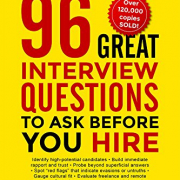
96 Great Interview Questions to Ask Before You Hire
By Paul Falcone
Every manager and human resources department has seen it time and time again–candidates whom they viewed from across the table as promising individuals loaded with potential turning out to be disappointing and underwhelming employees. Meanwhile, numerous resources are wasted yet again while the company continues to seek out the right fits for their needs. Is this just a rite of passage for all businesses, or is there a way to simplify the hiring process and put people in place the first time who can get the job done?The third edition of this practical and wildly popular hiring classic provides the keys to getting the results you’re looking for during the interviewing and hiring process! Employment expert Paul Falcone has packed this resource full with all the interview questions you might possibly need to ask any candidate, so as to best reveal the real person sitting across from you. What is the applicant’s motivation for changing jobs? How well does he handle stress? Does she consistently show initiative? The various questions have been tailored to sales, mid-level, or senior management positions. There are questions to gauge likability and fit. There are even pressure-cooker questions that will no doubt reveal eye-opening characteristics about the candidate that you would not have learned otherwise.Complete with guidelines for analyzing answers, asking follow-up questions, checking references, and making winning offers, 96 Great Interview Questions to Ask Before You Hire covers the interviewing and hiring process from beginning to end, leaving no stone unturned.
About the Author
Paul Falcone (www.PaulFalconeHR.com) is CHRO of the Motion Picture & Television Fund in Woodland Hills, CA, and he’s held senior-level HR positions with Nickelodeon, Paramount Pictures, and City of Hope. He has extensive experience in entertainment, healthcare/biotech, and financial services, including in international, nonprofit, and union environments.
Paul is the author of a number of bestselling HarperCollins, AMACOM, and SHRM Books, many of which have been ranked as #1 Amazon bestsellers in the categories of human resources management, labor & employment law, business mentoring & coaching, communication in management, and business decision-making and problem-solving. His books have been translated into Chinese, Korean, Vietnamese, Indonesian, and Turkish.
Paul is also a long-term contributor to HR Magazine, a top-rated conference presenter, and an adjunct faculty member in UCLA Extension’s School of Business and Management.
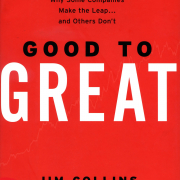
Good to Great
Why Some Companies Make the Leap and Others Don’t
By Jim Collins
The Challenge:
Built to Last, the defining management study of the nineties, showed how great companies triumph over time and how long-term sustained performance can be engineered into the DNA of an enterprise from the very beginning.
But what about the company that is not born with great DNA? How can good companies, mediocre companies, even bad companies achieve enduring greatness?
The Study:
For years, this question preyed on the mind of Jim Collins. Are there companies that defy gravity and convert long-term mediocrity or worse into long-term superiority? And if so, what are the universal distinguishing characteristics that cause a company to go from good to great?
The Standards:
Using tough benchmarks, Collins and his research team identified a set of elite companies that made the leap to great results and sustained those results for at least fifteen years. How great? After the leap, the good-to-great companies generated cumulative stock returns that beat the general stock market by an average of seven times in fifteen years, better than twice the results delivered by a composite index of the world’s greatest companies, including Coca-Cola, Intel, General Electric, and Merck.
The Comparisons:
The research team contrasted the good-to-great companies with a carefully selected set of comparison companies that failed to make the leap from good to great. What was different? Why did one set of companies become truly great performers while the other set remained only good?
Over five years, the team analyzed the histories of all twenty-eight companies in the study. After sifting through mountains of data and thousands of pages of interviews, Collins and his crew discovered the key determinants of greatness — why some companies make the leap and others don’t.
The Findings:
The findings of the Good to Great study will surprise many readers and shed light on virtually every area of management strategy and practice. The findings include:
- Level 5 Leaders: The research team was shocked to discover the type of leadership required to achieve greatness.
- The Hedgehog Concept: (Simplicity within the Three Circles): To go from good to great requires transcending the curse of competence.
- A Culture of Discipline: When you combine a culture of discipline with an ethic of entrepreneurship, you get the magical alchemy of great results. Technology Accelerators: Good-to-great companies think differently about the role of technology.
- The Flywheel and the Doom Loop: Those who launch radical change programs and wrenching restructurings will almost certainly fail to make the leap.
“Some of the key concepts discerned in the study,” comments Jim Collins, “fly in the face of our modern business culture and will, quite frankly, upset some people.”
Perhaps, but who can afford to ignore these findings?
Recommendation
Click here to add your own text
Takeaways
Click here to add your own text
Summary
Click here to add your own text
About the Author
Click here to add your own text
What To Do When There’s Too Much To Do: Reduce Tasks, Increase Results, and Save 90 a Minutes Day
Reduce Tasks, Increase Results, and Save 90 Minutes a Day
By Laura Stack
Are you tired of productivity consultants—or worse, your boss—pushing you to do more with less? You’re in luck. Laura Stack knows your to-do list is already packed to capacity, so she shows you how to accomplish more by doing less. Yes, you read that right. Stack’s innovative time-management system lets you work less and achieve more.
Following Stack’s step-by-step Productivity Workflow Formula, you’ll organize your life around the tasks that really matter and—this is crucial—let go of those that don’t. Dozens of practical strategies will help you reduce your commitments, distractions, interruptions, and inefficiencies. You’ll shrink your to-do list and save time—around ninety minutes a day—while skyrocketing your results and maintaining your sanity.
Recommendation
Productivity expert Laura Stack offers simple, innovative ways to help you enjoy a more productive and meaningful workday. She shows you how to prioritize your workload and create realistic daily, weekly and yearly work schedules by decluttering your files and inbox, identifying what’s really important, streamlining your workload and making more effective decisions. Some of her suggestions pertaining to health and exercise are extremely helpful, but can be found in other advice manuals. Nevertheless, most of her organizational ideas are novel and worth implementing.
Takeaways
- To do less work – and higher-quality work – each day, follow the six-step “Productivity Workflow Formula”:
- First, “determine what to do.” Clean up your to-do list. Track only goal-related items.
- Separate tasks into what is due today and what you can do later.
- Second, “schedule time to do it.” Assign a realistic deadline to each task.
- Decline colleagues’ requests to do tasks that are not your responsibility.
- Third, “focus your attention.” Don’t gossip or surf the web. Exit meetings that run late. Don’t multitask – you’ll feel busy but be less productive.
- Jot down or voice-record ideas as you think of them to recall them more quickly.
- Fourth, “process new information.” Handle incoming messages, paperwork and other information immediately.
- Fifth, “close the loop.” Bring tasks to a conclusion and stay on top of your priorities.
- And sixth, “manage your capacity.” Take care of your health – eat well and exercise.
Summary
“The Case for Reduction”
More is not better. You can be successful even if you do less. Studies show that a “60-hour work week results, on average, in a 25% decrease in productivity.” To channel your energy more efficiently, use the six-step “Productivity Workflow Formula”:
1. “Determine What to Do”
Examine your to-do list. If it’s filled with tasks with assorted due dates, it’s probably long and overwhelming. If you’ve thrown in some items you couldn’t say no to doing, your list is probably downright frightening! To decide what stays on your list, estimate your “personal return on investment” – that is, the value you offer your company. Demonstrate that you’ve earned or saved your firm “at least three times your base salary” each year. If you can’t determine a financial value, find a way to show how your company would suffer from your absence. Evaluate each task you do based on your personal value:
- What tasks are most important? – List your 10 most important responsibilities. Does your list match your boss’s perception of your priorities and value? If the two accounts differ, you are not giving your organization your best efforts.
- What do you care about? – Retain and follow through on tasks that you must complete by the end of the workday to feel satisfied.
- Keep tasks that further your goals – “Cut, cut and cut” all items that don’t move you forward. Delegate tasks that don’t benefit you.
“Do less, not more, so you can do better, more focused work.”
Drop time-wasters from your day, such as repeated email checks and Internet visits. Gossip is time consuming and poisons the work environment. Make a “not-to-do list” of tasks you “simply refuse to do.” Prioritize desired items on a “high-impact task list” of today’s work or a “master list” of future work.
2. “Schedule Time to Do It”
Assign a realistic deadline to each task. Do most of your work when you feel focused and energized. Exit meetings that run late or veer off topic. Don’t accept work that should go to someone else; simply refuse such chores in a positive way. Say, “I’d love to but just can’t take that on right now!” or “But please keep me in mind for any further projects.” Be gracious but, when you decline a request, never explain why. Don’t schedule unnecessary meetings. Estimate the hourly salary of everyone who’s coming to a meeting to see if its cost makes financial sense.
3. “Focus Your Attention”
Workers typically waste 28% of their day handling interruptions.
- Discourage your colleagues from chatting near your desk.
- Play calming music to drown out distracting noise.
- Limit discussions with co-workers.
- Excuse yourself from office politics.
- Come to work on time and take shorter lunch breaks.
- Don’t multitask.
“The true source of productivity isn’t nonstop ouput; it’s a refreshed and energized mind.”
You waste several seconds each time you move from one chore to another. Those seconds quickly add up to hours of lost time. To avoid procrastination, break big tasks down into smaller jobs and set deadlines for each one. Jot down or voice-record your ideas so you don’t waste time trying to remember them later. Sort ideas into “memory lists” by topics, such as “article ideas, blog topics, birthdays” or “books to read.”
4. “Process New Information”
Reduce the amount of daily data you receive. If you can, have staffers sort your email and delete time-wasters. Unsubscribe from nonproductive mailing lists. If it takes more than 60 seconds to locate an item, consider using the “6-D Information Management System”:
- “Discard” – Don’t keep paper or emails because you think you’ll need them later. Heed the “start-to-finish rule”: scan the data, make any required decisions and act.
- “Delegate” – Reassign any item that does not help you advance toward your goals.
- “Do” – Act on the item now.
- “Date” – If you need to put off a task, assign it a realistic due date.
- “Drawer” – File important items that don’t require immediate action.
- “Deter” – Stop unwanted messages from coming again.
“Reducing your commitment load to the bare minimum, so you can most effectively use your time at work…makes you more valuable to the organization.”
Process inbox items immediately. Don’t use your inbox as a to-do list or filing system. Instead, make a “tickler file” – a chronological file to check at regular intervals for date-specific reminders, notes and messages. A tickler file is a “rotating annual calendar for paper,” though you can set it up on your computer as well.
5. “Close the Loop”
Be on top of your tasks. Focus on your goals, make your deadlines and transmit information clearly. The president of an automotive parts manufacturing corporation once contacted his finance department to request a cost quote for a talk he planned to give. He wanted a ballpark value, a number that would take only a few minutes to compute. Unfortunately, the staff member misinterpreted the assignment and thought the president needed an accurate quote. He spent hours putting an estimate together. Their misunderstanding wasted time and money. When you speak to your team or to co-workers, be clear and concise.
“If one of your tasks properly belongs to someone else, hand it back to them – even if they don’t want it. Your work must come first, so stop being so darn nice.”
Micromanagers waste your time. You can’t increase your efficiency if your boss hangs around repeating directions and demanding frequent updates throughout the day. If you can’t move to the purview of a new supervisor or change your boss’s behavior, then confront the boss or consider changing jobs. If all else fails, then do everything a micromanager asks. It’s time consuming, but complying may be the most functional solution. You might try “micromanaging the micromanager.” Bombard your boss with so many details that they finds the interactions unbearable. Anticipate your boss’s needs and provide information before they ask for it. Regardless of which option you choose, protect yourself: Document your encounters with a controlling boss and insist on receiving all directives in writing. These steps will help you defend yourself if a manager tries to blame you for any mishap.
“In recent surveys, workers have admitted to wasting an average of two hours per workday, and approximately an hour of it is online.”
Don’t tolerate time-wasting processes. For example, author Laura Stack had a problem with her smartphone, which would display her email only when the battery was fully charged. She had to charge her phone every night without fail. If she forgot, which inevitably occurred, she would miss important messages the following day. She knew she needed a new phone but wasn’t due an upgrade for a year. If she bought one immediately, she would have to pay top dollar. After missing several crucial messages, Laura decided to bite the bullet and get a new phone. Even though she spent more, she became more efficient and rid her life of a time-wasting and worrisome issue.
6. “Manage Your Capacity”
Your health comes first. If you don’t take care of yourself, you won’t have the capacity to work efficiently. When you overwork, your productivity wanes. Set realistic expectations. You’ll perform at your best when you are rested. Take a morning and an afternoon break. Eat often. You might feel light-headed if you go longer than six hours without food. Skipping meals is unhealthy and can cause your blood sugar level to drop. When it’s lunchtime, leave the office. Don’t eat at your desk. Also, savor your big breaks – “weekends, holidays and vacations.” It isn’t enough to sit in front of the television and think about work. To adequately recharge your batteries, leave work behind. Do something you love to do.
“If you don’t already, learn to love what you do – or change careers. You can’t maximize your productivity if you don’t enjoy your work.”
Don’t underestimate the regenerative power of sleep. When you lack sleep, you are “basically slamming a wrecking ball through your energy levels.” Sleep resets your natural circadian rhythms on a daily basis. The brain’s hypothalamus, which regulates these rhythms, is in charge of your physical status, “energy, activity and how you feel.” Researchers who studied 500 million Twitter messages found that, regardless of where people live, the messages they post during the mornings and evenings tend to be more upbeat; those they submit during the afternoon or at night are far less positive. Researchers say that poor sleep habits cause these emotional changes.
“You aren’t a robot. Long hours lead to physical and mental fatigue, which results in slower work, more mistakes and wasted time.”
If you adhere to Ben Franklin’s wise words, “Early to bed, early to rise,” you’ll stay on the right track. An early bedtime helps you “supercharge your adrenal glands,” which produce adrenaline, cortisol and DHEA. Cortisol wakes you up, and DHEA calms you down. The more sleep you get, the greater the amount of DHEA your body produces. If you stay up late, rest by sleeping late the following morning. To sleep better, follow these guidelines:
- “Control the thermostat” – Keep your bedroom between 68˚F and 72˚F [20˚C-22˚C].
- “Shut out the snoring” – If your bedmate snores, get earplugs.
- “Take a power nap” – According to a study in Nature Neuroscience, a daytime nap of an hour or less can improve your performance afterward.
- “Keep your bedroom sleep-related” – Do your work, texting and computer tasks in another part of your home – never in your bed.
“Never confuse activity with productivity.”
Eat healthy. Weighing too much will cut your energy. To eat less so you work more effectively throughout your day, follow these tips:
- “Put only two things at a time on your plate” – According to experts at Cornell University, individuals who only took “two items at a time” consumed 21% less food.
- “Cut 500 calories per day out of your diet” – It takes 20 minutes for your brain to get the “‘I’m stuffed’ signal.” Slow down as you eat or build a break into your meal. For example, go to one eatery for your main course and another restaurant for dessert. Chances are, your appetite will drop by the time you get to the next location, and you will order a smaller treat.
- “Eat a salad before your meal” – Experts at Penn State say folks who eat salad first lower their caloric intake by 12%.
- “Change your dinnerware to reflect correct portions” – Eat your meals on a smaller plate. You will take smaller portions and think twice before getting more.
- “Automatically ask for a box” – When you eat out, ask your waiter to pack up a portion of your food as soon as it comes to the table. Don’t wait until the end of the meal. If you want to split your meal with a friend, have the waiter divide the portions onto separate plates before bringing the meal to your table.
- “Always eat your morning meal” – Don’t forget to eat breakfast. Skipping meals interrupts your body’s “steady flow of glucose.”
“Stop multitasking. It just dilutes your attention and fools you into thinking you’re productive, when you’re really just busy.”
Be active. If you move less, you will have less energy.
- A 10-minute energetic walk revs up your engine and keeps your energy up for a couple of hours.
- To pack more physical activity into your day, park further away from work and walk.
- Take a stroll at lunchtime.
- Don’t message co-workers; walk to their offices.
- Walk back and forth when using a speakerphone; pace as you talk on your cellphone.
- Take the stairs instead of the elevator.
- Invite your family to walk with you after supper.
- Watch your favorite television program while you use a treadmill or stationary bicycle.
- Use the copier or bathroom on another floor of your office building and take the stairs.
- If you take a subway to work, trot up and down every staircase – never walk.
- Don’t use the moving walkway at the airport.
“At the end of every workday, take a moment to ask yourself: ‘Was I productive today, or did I just stay busy?’”
To bring more joy to your life, take these measures:
- “Make empowered choices” – Eeyore, the mopey donkey in the Winnie the Pooh series, always saw the dark side of life. His glass was permanently half empty. On the other hand, Tigger, another Winnie the Pooh character, bounced around with zest for life. Be like Tigger. Stop thinking that bad things happen only to you. The choices you make can change the direction of your life. Hang around with folks who have positive attitudes.
- “Spend more time with your family” – When you spend time with those you love, you recharge your energy level. This quality time is a “balm for your soul.”
- “Do something nice for someone” – Benefit from the “helper’s high.” When you act kindly toward someone else, your body circulates mood-lifting endorphins.
About the Author
Laura Stack, head of The Productivity Pro, is a keynote speaker and author of Leave the Office Earlier, Find More Time, and three other books.
The Hard Thing About Hard Things
Building a Business When There Are No Easy Answers
By Ben Horowitz
Ben Horowitz, cofounder of Andreessen Horowitz and one of Silicon Valley’s most respected and experienced entrepreneurs, offers essential advice on building and running a startup—practical wisdom for managing the toughest problems business school doesn’t cover, based on his popular ben’s blog.
While many people talk about how great it is to start a business, very few are honest about how difficult it is to run one. Ben Horowitz analyzes the problems that confront leaders every day, sharing the insights he’s gained developing, managing, selling, buying, investing in, and supervising technology companies. A lifelong rap fanatic, he amplifies business lessons with lyrics from his favorite songs, telling it straight about everything from firing friends to poaching competitors, cultivating and sustaining a CEO mentality to knowing the right time to cash in.
Filled with his trademark humor and straight talk, The Hard Thing About Hard Things is invaluable for veteran entrepreneurs as well as those aspiring to their own new ventures, drawing from Horowitz’s personal and often humbling experiences.
Recommendation
Ben Horowitz guided Loudcloud through life-or-death struggles before selling it to Hewlett-Packard for $1.65 billion. He argues that no formula can promise entrepreneurial success. Horowitz is a first-rate storyteller and a refreshingly irreverent teacher who uses allusions ranging from Jay Z to Clint Eastwood to Dr. Seuss. Any business leader will find worthy guidance in this exhortation to persist through “the Struggle.” getAbstract recommends Horowitz’s part autobiography, part tip sheet to anyone building a company.
Takeaways
- You may start a company with high hopes, but eventually – like Ben Horowitz at Loudcloud – you’ll experience “the Struggle.”
- Horowitz didn’t struggle alone; he enlisted the best minds in order to address his company’s problems.
- His advice: Put your people first, then your products, and then your profits.
- People with “the right kind of ambition” care about the team’s success.
- Don’t convey only optimism; be honest about threats to the company.
- Managers should deliver news of firings to their people with compassion; never outsource this task to HR.
- Minimize politics about pay, promotion and territory with well-designed processes.
- Company culture drives behavior that moves the firm toward its goals.
- Build your knowledge daily through small interactions with customers and employees.
- The founders of successful start-ups like Loudcloud share one quality: They don’t quit.
Summary
Loudcloud, Opsware and “the Struggle”
Every start-up encounters the Struggle. Your product turns out to have costly flaws. Your cash runs low, and your venture capitalist tells you fund raising seems unlikely. A loyal customer leaves you. A valuable employee walks away.
There’s no way around the Struggle and no formula for fixing your problems. Your company might not make it. Entrepreneurs who make it share one characteristic: They don’t quit.
“Hard things are hard because there are no easy answers or recipes…They are hard because you don’t know the answer and you cannot ask for help without showing weakness.”
Netscape veterans Ben Horowitz and Marc Andreessen founded Loudcloud, a cloud services provider, in 1999 and soon hit a rocky road. Seven months after they launched Loudcloud – its name marked the first time “cloud” had been used popularly to describe a computing environment – Horowitz and Andreessen had booked $10 million in contracts. They were hiring so fast – 30 employees a month – that workers had to sit in the hallways.
“There are no shortcuts to knowledge, especially knowledge gained from personal experience.”
Then came the dot-com crash of 2000; the NASDAQ fell by 10%. Loudcloud needed capital but faced long odds. After Horowitz pitched one set of prospective backers, a colleague told him the skeptical investors “thought you were smoking crack.” Loudcloud raised a total of $120 million, but with so many start-ups collapsing, the company’s bookings fell far short of its forecasts.
“The Struggle is when you wonder why you started the company in the first place. The Struggle is when people ask you why you don’t quit and you don’t know the answer.”
Horowitz and his board, seeing few prospects for investment from the private market, decided to take Loudcloud public. It was a risky move, with just six weeks of cash remaining in the worst possible environment for a technology IPO. The company took a pounding in the press: BusinessWeek called it “the IPO from hell.” The offering debuted at $6 a share and the company raised $162.5 million, but nobody celebrated. As the dot-com downturn worsened, the company laid off 15% of its workforce and its stock fell to $2.
“Every great entrepreneur from Steve Jobs to Mark Zuckerberg went through the Struggle…so you are not alone. But that does not mean that you will make it.”
Horowitz engineered a deal to sell the cloud business to EDS for $63.5 million and remake Loudcloud as a software company built around its intellectual property, Opsware. Investors balked: Its share price plummeted to 35 cents before slowly recovering.
As Horowitz built the software business, he again responded to crises with bold moves. When a key customer threatened to defect, Opsware bought a North Carolina company that provided the client the software he wanted. When a major new competitor began pummeling Opsware in the marketplace, Horowitz launched the Darwin Project, during which staffers worked 14 hours per day, seven days per week, for six months.
“Managers must lay off their own people. They cannot pass the task to HR…if you hired me and I busted my ass working for you, I expect you to have the courage to lay me off yourself.”
After Herculean labors, Opsware’s software business “approached a $150 million revenue run rate,” and its stock sometimes traded at a market capitalization of more than $800 million. Horowitz decided to entertain offers for Opsware, but only at $14 or more a share. Eventually, Hewlett-Packard agreed to acquire the company for $14.25 a share or $1.65 billion in cash.
“The first thing that any successful CEO must do is get really great people to work for her.”
Selling the company was wrenching, but Horowitz came to regard it as the smartest move of his career. “We’d built something from nothing, saw it go back to nothing again and then rebuilt it into a $1.65 billion franchise.”
Getting Through the Hard Times
As he guided Loudcloud and then Opsware through difficult days, Horowitz drew strength from the lessons he learned:
- “Don’t put it all on your shoulders” – As CEO, you can’t share everything, but remember that you don’t have to bear every burden alone. Muster as many brains as possible to attack a problem.
- Remember “there is always a move” – Running a company is like playing chess: When you think you’re out of moves, think again. You always have a move.
- “Play long enough and you might get lucky” – The technology environment changes so fast that you might find the elusive answer another day, if you can just hang on.
- “Tell it like it is” – At first, Horowitz thought his role as CEO required him to set a positive tone and avoid letting the workforce know the gravity of the company’s problems. Instead of motivating the troops, that approach compromised his credibility. As CEO, you’re better off sharing information about your firm’s problems with those who can harness their energy toward solving them.
Dealing with Layoffs and Firings
Horowitz’s company went through three separate layoffs involving a combined 400 employees. Few start-ups recover from consecutive layoffs of that magnitude, because they break the trust of those left behind. Horowitz believed Loudcloud was able to keep its best employees after multiple layoffs because “we laid people off the right way.”
“Even with all the advice and hindsight in the world, hard things will continue to be hard things.”
If you must cut staff, begin the layoffs as soon as possible after deciding to do so, because word about dismissals leaking out may cause further and even greater problems. Have managers deliver the news to their own people; never outsource it to human resources. Managers should explain that the layoffs stem from a company failure, not the employees’ personal failures. They should make clear the decisions are nonnegotiable and should explain severance packages fully.
“Build a culture that rewards – not punishes – people for getting problems into the open where they can be solved.”
When you fire an executive, the first step is figuring out why you hired the wrong person in the first place, or you’ll be firing another executive soon. Maybe you hired “for lack of weakness rather than for strengths.” Or maybe you didn’t define the position correctly at the outset.
The Three P’s
Jim Barksdale, Horowitz’s old boss at Netscape, once said, “We take care of the people, the product and the profits – in that order.” If people like working for your company and you look out for them, they will reward you with loyalty and hard work. If you don’t take care of your people, the product and the profits won’t matter.
“The most important thing I learned as an entrepreneur was to focus on what I needed to get right and stop worrying about all the things that I did wrong or might do wrong.”
Taking care of people means training them well and having managers regularly meet one-on-one with their direct reports. It also means avoiding “management debt.” That accumulates when you make a short-term management move that has costly, long-term consequences. Examples would be overcompensating an employee who has a competing job offer or putting two people in the same job because you want to keep both in the company. The best CEOs avoid acquiring management debt. Faced with cutting a popular project that’s not in the company’s long-term plans or keeping it for morale purposes, they’ll cut it every time. They make hard decisions that “ruffle the feathers.”
Running Your Growing Company
If you’re fortunate enough to see your company reach 1,000 employees, it will be a profoundly different organization than when you employed 10 people. You must cope with new challenges:
- Minimizing company politics – Political behavior can seep into a variety of corporate activities, including performance reviews, pay, organizational structure, territory and promotions. Curtail political behavior by designing strict processes and following them relentlessly. Be sure everyone understands your promotion process. When you decide to reorganize, do it quickly, without leaving time for lobbying.
- Hiring employees with the “right kind of ambition” – Go for candidates who see through a “team” lens and whose ambition focuses on being part of a winning company.
- Promoting a strong culture – Some start-ups boast about letting employees bring pets to work or offering yoga classes. Those are perks, not culture. True culture drives behavior. Consider Amazon: To keep costs down, Jeff Bezos declared that the company would make all its desks out of cheap doors from Home Depot.
What Makes a Leader?
A CEO should have some combination of the following traits:
- “The ability to articulate the vision” – Steve Jobs persuaded Apple employees to believe in his vision even when the company was near bankruptcy.
- “The right kind of ambition” – A leader creates an atmosphere of shared ambition and trust, a quality Bill Campbell exemplified at Intuit and other organizations.
- “The ability to achieve the vision” – This quality helped Andy Grove win the trust of Intel employees as he led them through a brilliant gambit: moving from the memory business to the microprocessor business.
“Every really good, really experienced CEO…tend[s] to opt for the hard answer to organizational issues…They’ll ruffle the feathers.”
As CEO, work on all three qualities, even though you might be stronger in one or two. Each quality enhances the others. If you can persuasively articulate a vision, for example, employees will trust you and be patient with you as you lead them toward it.
Ask three questions to judge how well a CEO performs: 1) “Does the CEO know what to do?” 2) “Can the CEO get the company to do what she knows?” and 3) “Did the CEO achieve the results against an appropriate set of objectives?”
“Peacetime CEO focuses on the big picture…Wartime CEO cares about a speck of dust on a gnat’s ass if it interferes with the prime directive.”
Knowing what to do involves using strategy and sharp decision making. Acting strategically takes courage, because you’ll never have enough time to gather all the information you really need. That’s why you must keep acquiring knowledge, day by day, from many small interactions with customers and employees. When you must make a decision, you’ll be better prepared to answer questions like: How might our competitors respond? What’s the financial risk? How will employees take this?
“Focus on where you are going rather than on what you hope to avoid.”
To get the company to “do what you know,” build a workplace where employees can get things done. “The employees must be motivated, communication must be strong, the amount of common knowledge must be vast and the context must be clear.” The scale of your objectives should align with the scale of your company’s opportunities.
“If you don’t want to be great, then you should never have started a company.”
During the toughest times, take care of your own psychological state. “Techniques to calm your nerves” include recruiting trusted confidantes, putting your thoughts on paper, and focusing on your destination rather than on what might go wrong.
When to Sell Your Company
One of your toughest decisions may be when to sell. Consider two questions: Are you very early in a potentially large market? Do you stand a good chance of reaching number one in that market? If the answer to either question is no, you should consider selling. When Google was young, the company received multiple purchase offers for more than $1 billion. But Google did not sell. Its answer to both questions would have been yes. Google was very early in a market that would be larger than all the markets the would-be buyers owned. And Google had built a high-quality product that would be number one.
When Horowitz first fielded inquiries about selling Opsware, the company had fewer than 50 customers. Horowitz believed Opsware had at least 10,000 potential customers and could reach number one. By the time Opsware had attained several hundred customers, it became clear that a company called BMC was going to acquire either Opsware or a competitor, BladeLogic. In order to be number one, Horowitz concluded, Opsware would have to beat BMC and BladeLogic together. A new technology, virtualization, was transforming the market, which would push the company into a costly R&D race. In the end, Horowitz decided to sell.
Andreessen Horowitz
After selling Opsware to Hewlett-Packard, Horowitz joined with Andreessen to form a venture capital firm that would aid technology entrepreneurs. Besides investing in companies, their firm, Andreessen Horowitz, advises CEOs on the skills that company founders sometimes lack – managing executives, designing an organization and running a sales force. The most important lesson Horowitz tries to convey to entrepreneurs is that running a company is hard, a tough process with no easy answers. “The only thing that prepares you to run a company is running a company.” The solutions lie in the executive’s instinct, in the confidence that comes from experience and in the performance of this vital duty: “Embrace the struggle.”
About the Author
Ben Horowitz is a co-founder and general partner of Silicon Valley venture capital firm Andreessen Horowitz.
The One Minute Manager
The Quickest Way to Increase Your Own Prosperity
By Kenneth Blanchard
A revised edition of the timeless business classic—updated to help today’s readers succeed more quickly in a rapidly changing world.
For decades, The One Minute Manager® has helped millions achieve more successful professional and personal lives. While the principles it lays out are timeless, our world has changed drastically since the book’s publication. The exponential rise of technology, global flattening of markets, instant communication, and pressures on corporate workforces to do more with less—including resources, funding, and staff—have all revolutionized the world in which we live and work.
Now, Ken Blanchard and Spencer Johnson have updated The One Minute Manger to introduce the book’s powerful, important lessons to a new generation. In their concise, easy-to-read story, they teach readers three very practical secrets about leading others—and explain why these techniques continue to work so well.
As compelling today as it was thirty years ago, this classic parable of a young man looking for an effective manager is more relevant and useful than ever.
Review
This little book from the early 1980s was a phenomenon at the time. It sold 10 million-plus copies, inspiring updates and spinoffs like The One Minute Entrepreneur, and opening the door to countless other business parables. Prolific authors Kenneth Blanchard and Spencer Johnson – who co-wrote the best-seller Who Moved My Cheese? – keep the writing and structure purposeful. The story explores “One-Minute Management” principles with surprising charm. Blanchard and Johnson effectively use a parable to present their basic management advice. A bright young man who wants to become a manager in the future sets out to find an effective boss. After hunting high and low, he hears of a great manager who has a reputation for producing stellar results by working with his employees. He finally meets the manager, who shares his secrets. Blanchard and Johnson wrote this classic as a quick, easy-to-read story, using a novelistic framework as a dramatic way of highlighting their management ideas. This approach brings their description of commonsense business principles to life. Blanchard returned to the allegory form in 1998’s Gung Ho!, which he co-wrote with Sheldon Bowles. While some readers may want to get to the core of the lessons, which could be wrapped up in a few pages, the allegory tactic has proven very popular. getAbstract recommends this condensed, readable and accessible classic to everyone in business. It’s Management 101.
The Premise
A young man seeking effective managers meets “tough” bosses who emphasize results over people and “nice” supervisors who emphasize people over results.
He’s frustrated until he meets the actual “One Minute Manager,” who supports both “people and results.” The one-minute manager explains core ideas like, “People who feel good about themselves produce good results.”
The one-minute manager offers three management secrets to “help people reach their full potential.” He suggests using “One Minute Goal Setting” to boil goals down to one page (plus the applicable standards); “One Minute Praising” to give workers clear, brief compliments; and the “One Minute Reprimand” to tell workers quickly how they’ve erred while letting them know you value them as people and as employees. To help people reach their top performance, the mythical minute manager suggests, “catch them doing something right” and offer immediate praise. He tells his young protégé not to feel threatened when he encourages other people to reach their potential. The greater your employees’ successes, the higher you will climb in your company.
Blanchard and Johnson suggest praising your staff members as soon as they do something right. Make sure their colleagues know you praised them. When you praise people, look them directly in the eye and tell them exactly what they did right. Tell them how good you feel about their accomplishment. This helps employees become more aware when they do things right, so they will start praising themselves.
Setting and Meeting Goals
Goal-setting follows the 80/20 principle, which means that 80% of your desired results will come from only 20% of your goals. The authors say to prioritize the 20% of your goals that will bring the greatest returns. Select three to six goals, and communicate them to your employees. Ensure they understand that you consider these goals their main responsibilities and will hold them accountable. Once you set job responsibilities for your employees, clarify your expected “performance standards.” Honor those who reach them.
Spencer and Johnson urge encouraging your employees to identify and solve their own problems. If they need help, don’t focus on their attitudes or feelings. Help them analyze what’s happening in observable, measurable terms. If they can’t perceive and explain the problem, they’re just complaining. The authors assert that a real problem exists only when there is a difference between what an employee wants to happen and what is happening. Your employees, they say, should be able to create different solutions and devise possible outcomes to determine the best action.
Managers who set clear goals and guide their people by praising and reprimanding as per the three secrets must master honest communication, respect their workers, and commit to expending the time and energy to watch new staffers closely for significant periods of time. This advice marks where The One Minute Manager’s real-world problems begin.
Pat Homilies
Six staffers report to the book’s one-minute manager, who apparently only supervises and counsels. The book never addresses strategy, planning, corporate organization or company policies. Blanchard and Johnson indulge in disingenuous management-speak and use pat homilies that would cause modern workers to roll their eyes like laundry dryers, for example, “Nobody ever really works for anybody else” and “I don’t make decisions for other people.” This can’t be true even in the universe of the book’s fictitious firm. Someone has executive and veto power and makes decisions for other people. One-minute magic seems best designed for established businesses and fast action. Even 30 years ago, this wouldn’t work for a disrupted business, during periods of rapid technological change or in any industry where results take years to unfold.
Feedback
The advice that consistent, objective feedback shows your concern for your employees seems more durable. Correctly presented, feedback can boost employees’ dedication, commitment and performace. Improving your employees pays off financially. The most productive minute you can put in, Blanchard and Johnson explain, is the one you spend “investing” in your people. Feedback about results is “the number one motivator.” Receiving high-quality feedback enables people to adjust their behavior. For example, when someone is bowling, he or she needs to see the pins. As the pins fall or remain standing, a bowler understands instantly the results of his or her effort. That is instant feedback.
“NIHYSOB”
The authors caution against the common, unfair mistake of not telling people what you expect of them and then telling them they did something wrong when they didn’t do what you expected. This is the NIHYSOB (or gotcha) approach to employee management. The acronym means “Now I have you, you SOB!” Insecure or incompetent managers revel in this attitude because taking it always puts an employee on the defensive or in the wrong. NIHYSOB often rears its ugly head when mediocre or easily threatened managers conduct performance reviews. Few tactics irritate employees more or do a better job of spurring them to seek employment elsewhere.
Few moments in The One-Minute Manager date it quite as much as this sort of outdated slang and clumsy acronym. NIHYSOB best illustrates the difference between the era of the authors’ writing and today. But it is handy as a bona fide worst example. If you can read the NIHYSOB section and still recognize this book’s underlying worth and timeless message, then the book’s slightly dated style won’t put you off its better bits of advice.
Conditioning Behavior
The one-minute manager advises reviewing your goals and checking your achievements against those goals. When you think about your objectives, examine your performance and ask yourself if your behavior matches your goals. And now that you’ve checked yourself, check your staff. If an employee’s behavior doesn’t match your goals, apply the principles of conditioning to help the staff member align his or her behavior more closely. The process works like training pigeons. To train a pigeon to walk to a pellet machine in the far corner of a box, you draw a line near the entrance at the opposite corner. Each time the pigeon crosses the line, you reward it with a food pellet and draw new lines further from the entrance and closer to the pellet machine. Eventually the pigeon will run to the far corner to get the pellets. Reward people every time they come closer to their goals. Reward by reward, they will manifest the desired behavior or achieve the set goals.
About the Author
Kenneth Blanchard, PhD, is a writer, speaker, trainer and business consultant. His One Minute Manager sold more than 10 million copies and has been translated into more than 20 languages. He wrote Raving Fan and co-founded Blanchard Training and Development. Spencer Johnson, MD, originated the One Minute System. His bestsellers include The Precious Present and Yes or No: The Guide to Better Decisions. He also co-wrote the bestseller Who Moved My Cheese?
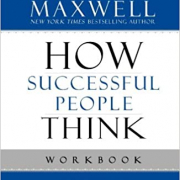
How Successful People Think
15 Ways to Get Ahead in Life
By John Maxwell
Gather successful people from all walks of life — what would they have in common? The way they think! Now you can think as they do and revolutionize your work and life!
A Wall Street Journal bestseller, How Successful People Think is the perfect, compact read for today’s fast-paced world. America’s leadership expert John C. Maxwell will teach you how to be more creative and when to question popular thinking. You’ll learn how to capture the big picture while focusing your thinking. You’ll find out how to tap into your creative potential, develop shared ideas, and derive lessons from the past to better understand the future. With these eleven keys to more effective thinking, you’ll clearly see the path to personal success.
The 11 keys to successful thinking include:
- Big-Picture Thinking – seeing the world beyond your own needs and how that leads to great ideas
- Focused Thinking – removing mental clutter and distractions to realize your full potential
- Creative Thinking – thinking in unique ways and making breakthroughs
- Shared Thinking – working with others to compound results
- Reflective Thinking – looking at the past to gain a better understanding of the future.
Recommendation
Well-regarded pastor and popular speaker John C. Maxwell shares a wealth of knowledge and experience in leadership and management in many of his books. But this time he turns toward personal development and offers 15 principles that can help you grow as a person so you can attain your full potential. Maxwell explains that change fuels “intentional personal growth,” but to achieve positive change, you must do one thing differently every day. “If you do the things you need to do when you need to do them, then someday you can do the things you want to do when you want to do them.” While probably too sweet for anyone with a drop of cynicism, Maxwell’s writing overflows with aphorisms and quotable gems. Give him an ear, and he may well help you change in a more positive direction.
Takeaways
- The measure of a life well lived is not how much you accomplish, but how much you help others.
- Your life’s purpose includes attaining your full potential.
- Reaching it requires “intentional personal growth.”
- You also need character, passion and a positive attitude.
- Personal growth doesn’t occur randomly or by accident. You must make it happen.
- To that end, develop your skills, leverage your strengths and enhance your spirituality.
- More than any other factor, associating with the right people can contribute to your personal growth. The wrong people can discourage you and inhibit your development.
- To grow as a person, you must have faith in yourself.
- Making individual progress is tough and takes time. It requires strong discipline.
- You will evolve as a person when you deal forthrightly with your problems.
Summary
What’s Your Potential?
When you embrace all your possibilities and extend yourself to achieve your full potential, you will become the completely realized person you were meant to be. “Intentional personal growth” is the road to attaining your potential, but it requires making a conscious decision to adopt the right attitude, passion and character to call upon your full strength and develop your special skills.
“Personal growth doesn’t just happen on its own. Once you’re done with your formal education, you must take complete ownership of the growth process.”
Pursuing personal growth will help you enhance your relationships, expand your horizons and become a more effective person. Start by creating a “growth journal” to track the way you develop. To reach your goals and your potential, apply 15 principles of intentional growth:
1. “Become an Intentional Learner”
Personal growth doesn’t occur automatically or by accident. You must plan the steps to achieving intentional growth. Take full ownership of your own progress. Don’t fall prey to common misperceptions, such as:
- “I don’t know how to grow” – Start by thinking about who you want to be. Write down steps you can take beginning today to help you become that person.
- This is “not the right time to begin” – Right now is always the best time to start a self-improvement program.
- “I’m afraid of making mistakes” – Everyone makes mistakes; learn from them.
- “I have to find the best way before I start” – To discover the best way to grow, first you must start on that path.
- “I don’t feel like doing it” – Growing is better than stagnating. Commit to spending at least a year on self-development.
- “Others are better than I am” – That’s fine; but you can learn from them.
- “I thought it would be easier” – Nothing good ever comes easy.
“Potential…looks forward with optimism. It is filled with hope. It promises success. It implies fulfillment. It hints at greatness.”
Move beyond these misconceptions and begin to grow. To start, ask yourself where you “want to go.” Answer that question, and then start your journey toward that destination.
2. “Develop Self-Awareness”
You can’t grow if you don’t know who you are, or can’t identify your strengths, weaknesses and passions. Begin a process of self-discovery. Think deeply about who you are and where you want to go. “Do you like what you’re doing now?” If not, risk trying something new. Ask yourself, “What would you like to do?” You can’t attain your destiny if you work at a job you detest. So decide what you want to do, examine why you want to do it and set out on that path.
3. “Believe in Yourself”
Many people never attain their full potential because they have poor self-esteem. They don’t believe they deserve to grow. Because they see themselves as flawed, people with low self-esteem cannot imagine ever being any better than they already are – which, according to them, isn’t much. If you feel like this, you’ll have to change your thinking to be able to grow.
“You cannot win if you do not begin! The people who get ahead…look for the circumstances they want, and, if they can’t find them, they make them.”
To improve your self-image, “guard your self-talk.” People constantly have conversations with themselves. Those with low self-image routinely criticize themselves. Don’t engage in negative self-conversations. Become a cheerleader for yourself. “Comparing yourself to others” is a fruitless exercise. Instead, “compare yourself to you.” “Celebrate small victories.” Remind yourself that each good, small step brings you “that much closer to success.” Always be positive with yourself. Be your own best friend.
4. “Set Aside Time to Reflect”
Personal growth requires stepping back, taking a pause and thinking carefully about your life. Find a place where you can stop and reflect, perhaps a secluded spot outdoors or a quiet room where no one will disturb you. Set aside 10 to 30 minutes each day to consider your life quietly and think about the kind of personal growth you want to achieve. Plan to spend regular periods of introspection one to two hours each week, a half-day several times a year, and a full day – or up to a week – annually. Think carefully about the areas where you most need to develop and grow.
5. “Embrace Discipline Daily”
Personal improvement requires time, hard work and consistency. Without discipline, you can’t grow or accomplish anything of value. It takes significant effort. Consider several facets of personal growth:
- “What” – Having a purpose is not enough. You must know “what you need to improve.”
- “How” – Deciding how to move ahead has four aspects: 1) Make sure your personality matches your motivation, 2) initially plan to “win small,” 3) demonstrate patience and 4) “value the process” by enjoying every minute of your growth journey.
- “Why” – Use your “why-power” to supplement your willpower.
- “When” – Right now. That’s the best answer.
6. “Seek Out a Positive Environment”
To establish a setting for intentional growth, seek “conducive surroundings.” Take a hard look at your current environment to see if it is going to help or hinder your personal-growth efforts. If negativity surrounds you, remove yourself from your current environment and seek a positive one.
“You cannot change your destination overnight, but you can change your direction overnight.” (Jim Rohn, entrepreneur and motivational trainer)
Your environment goes beyond location. It encompasses the people around you. Social psychologist David McClelland explains that the people you spend time with “determine as much as 95% of your success or failure in life.” So keep people around you who prop you up and don’t knock you down. Enlist “an accountability partner” who believes in you and your success.
7. “Become Highly Strategic”
Some people take control of their lives; others let life happen to them. Instead of choosing, try to develop a “strategic mind-set” so you can operate with a clear sense of urgency about leading a fulfilling life. Understand that life requires a proactive approach to be rewarding. Being strategic means designing what you want your life to be, just as you plan your career.
“Few things are better for cultivating character and developing humility than serving others.”
When you design a plan, double the time and money you allocate for everything. For example, if you estimate that a project will cost $1,000, put $2,000 aside. Thinking strategically calls for using “specific, orderly, repeatable principles and practices.” As you develop strategies and systems, keep them as simple as possible.
8. “Turn Negatives into Positives”
Everyone has troubles. But some people who’ve gone through bad times report that dealing with their problems made them a better person. In the process, their negative experiences became positive. Follow five steps “to turn your pain into gain”:
- “Choose a positive life stance” – Make optimism your basic frame of reference.
- “Embrace and develop your creativity” – For thorny problems, you may need unorthodox solutions.
- “Embrace the value of bad experiences” – Treat each trial as an opportunity to learn and grow.
- “Make good changes after learning from bad experiences” – Let traumas serve as turning points.
- “Take responsibility for your life” – Only you can be in charge of your own existence, no one else.
9. “Grow from the Inside Out”
Most people devote far more time and attention to developing their skills than to developing their character, but lack of character is the greater problem. Don’t worry about how you look on the outside; what counts is how you shape up on the inside. Your “inside victories” always matter more than your outside triumphs. Often, you can’t control what happens in your exterior space, but you can control what takes place in your interior space. When it comes to character issues, never take the easy road. “Hard-fought personal choices are not easily made, and they are not easily managed.” Yet, that’s when some of the most meaningful personal growth occurs.
10. “Get Used to Stretching Yourself”
“Rubber bands are useful only when they are stretched.” People are like rubber bands. To reach your full potential, expand your boundaries – “physically…mentally, emotionally and spiritually.” Many people don’t stretch themselves. They accept the status quo and remain stuck in their comfort zones. That makes it harder for them to achieve personal growth. To stretch, be ready to change. Be willing to try things that have frightened you in the past. Think about the goals you want to achieve, then motivate yourself to do what it takes to attain them.
11. “Make Smart Trade-Offs”
You can’t find the time and energy to grow if you aren’t willing to make some trade-offs. They may involve changing your job, forgoing the security of a comfortable salary, leaving your community or making other necessary sacrifices. Ask two questions when you consider making a trade-off. First, determine “the pluses and minuses.” Weighing the pros and cons might help you see how you exercise the natural tendency to overvalue what you already have and to undervalue what you could possibly gain through a trade-off. Second, decide if you will “grow through this change.” Don’t be timid. Try to view the trade-offs you must make to get ahead with enthusiasm. See them as special opportunities to grow.
12. “Learn to Ask More Questions”
Intentional growth depends in part on acquiring additional knowledge. The more you learn, the more you can grow. Don’t try to be an expert. Take on a “beginner’s mind-set,” like people who consider themselves “apprentices instead of experts.” This will give you a “humble, teachable posture.” Approach new knowledge with wonder, amazement and curiosity, like a child. Be inquisitive and always ask “why.” Don’t worry about looking silly or foolish. Try to gain a bit of new knowledge or a fresh experience every day: Take an art or dance class, or learn a martial art.
13. “Find a Good Mentor”
People with solid experience can teach you a great deal, whether you know them or learn from reading the books they write. When you line up a personal mentor, carefully select someone you respect. Find someone worth emulating who is available to assist you regularly. Your mentor should have excellent experience and knowledge. Seek a “next-step mentor,” someone a rung or two further up the career ladder ahead of you. Your mentor doesn’t have to be in your organization.
14. “Focus on Enlarging Your Potential”
Have you reached your full capacity as a person? Could you grow more? Of course, people can always increase their capacity by developing their ideas and actions. To change your thoughts, don’t ask, “Can I?” Instead, think, “How can I?” The first question limits you but the second one opens you up to amazing possibilities. To change your actions, break out of your mold. Start doing things you’ve never done before.
15. “Help Others Reach Their Potential”
The more you give to others, the more you will get in return. And, the more you grow, the more you will be able to give. Pitch in with your time and effort to help others realize their full potential. Whether at home or on the job, put other people ahead “of your own agenda. Put your family ahead of your own desires…Serve others instead of yourself.”
“If you can believe in yourself and the potential that is in you, and then focus on growth instead of goals, there’s no telling how far you can grow.”
To achieve this goal, be a giver, not a taker. Opt for significance over success. Don’t expect anything in return for your good deeds. Be intentional in your selfless efforts. “The measure of success is not the number of people who serve you, but the number of people you serve.” You will grow best when you help other people grow.
About the Author
John C. Maxwell is a leadership expert, speaker, coach and #1 New York Times best-selling author who has sold more than 25 million books. He is the founder of The John Maxwell Company, The John Maxwell Team, and EQUIP.
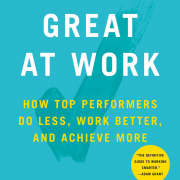
Great at Work
How Top Performers Do Less, Work Better, and Achieve More
By Morten Hansen
Wall Street Journal Business Bestseller
A Financial Times Business Book of the Month
Named by The Washington Post as One of the 11 Leadership Books to Read in 2018
From the New York Times bestselling coauthor of Great by Choice comes an authoritative, practical guide to individual performance—based on analysis from an exhaustive, groundbreaking study.
Why do some people perform better at work than others? This deceptively simple question continues to confound professionals in all sectors of the workforce. Now, after a unique, five-year study of more than 5,000 managers and employees, Morten Hansen reveals the answers in his “Seven Work Smarter Practices” that can be applied by anyone looking to maximize their time and performance.
Each of Hansen’s seven practices is highlighted by inspiring stories from individuals in his comprehensive study. You’ll meet a high school principal who engineered a dramatic turnaround of his failing high school; a rural Indian farmer determined to establish a better way of life for women in his village; and a sushi chef, whose simple preparation has led to his restaurant (tucked away under a Tokyo subway station underpass) being awarded the maximum of three Michelin stars. Hansen also explains how the way Alfred Hitchcock filmed Psycho and the 1911 race to become the first explorer to reach the South Pole both illustrate the use of his seven practices (even before they were identified).
Each chapter contains questions and key insights to allow you to assess your own performance and figure out your work strengths, as well as your weaknesses. Once you understand your individual style, there are mini-quizzes, questionnaires, and clear tips to assist you focus on a strategy to become a more productive worker. Extensive, accessible, and friendly, Great at Work will help you achieve more by working less, backed by unprecedented statistical analysis.
Summary
Business professor Morten T. Hansen launched a massive research project into what “working smarter” actually means. He tracked the practices and performance of 5,000 managers and employees and distilled the data into seven top-performance principles. The principles are simple – for example, winnow your tasks to the important few and focus on them intensely. Putting them into practice amid the pressures of modern business is more difficult. Hansen offers illuminating stories of people who use his principles effectively. The co-author of Great by Choice with Jim Collins, Hansen is an engaging writer who can find the drama in even dry business histories as he explicates the principles that underlie his stories. Anyone in the work world will gain focus and efficiency by reading this manual.
Working Smart
In 2011, Business professor Morten T. Hansen studied the work habits of 5,000 managers and employees to determine how and why some people excel. His team found that the top performers generally don’t work longer hours. Instead, they make each hour count by following seven “work-smart” principles. “Being great at work,” Hansen writes, “means performing in your job, infusing your work with passion and a strong sense of purpose, and living well, too.”
Principle One: “Do Less; Then Obsess”
When people strive to excel, Hansen points out, they often decide they should work more than everyone else. They load up their schedules with every available project and work long hours in hopes of accomplishing it all. Since they don’t have the time or resources to master the intricacies of all these tasks, they’re unlikely to turn in first-rate work on any of them. People who are overwhelmed need to coordinate the way their many tasks relate to each other, but instead they often end up constantly multitasking – that is, shifting their attention among activities, thus reducing their effectiveness at each task.
The best performers, Hansen learned, commit to a smaller range of priorities and concentrate on getting those done right, which means doing less and focusing more. The author provides a striking example of how the power of narrowing your focus affected the 1911 race to be the first to reach the South Pole. One team leader, Robert Scott, kept his options open. He prepared five ways to traverse the Antarctic: dogs, motorized sledges, ponies, skis and manual hauling. By contrast, the rival team leader, Roald Amundsen, focused on just one means of transport: sled dogs. Amundsen obsessed on sled dogs, learning all he could about the best breeds and hiring the best dog drivers for them. Amundsen won, in part because Scott had spread his attention over so many possible methods of transport that he didn’t get any of them right.
Hansen recognizes that narrowing your focus isn’t easy in a complex and fast-moving business environment. He provides these helpful strategies:
- Recalibrate how you measure accomplishment – Instead of calculating how many tasks you can take on, see how many you can eliminate and still reach your overall goal.
- Cut off your access to distractions – Just as Odysseus lashed himself to the mast of his ship to resist the temptations of the Sirens’ songs in Homer’s Odyssey, cut off your access to the digital siren call of email and the web. Remove internet capability from a laptop and designate it as your work-only computer. If your co-workers distract you, Hansen suggests that you arrive at your office an hour early and stay an hour late or commandeer an empty conference room.
- Involve your boss – Streamlining your focus is difficult if your boss sets vague goals or hands you more and more projects. Ask your boss to identify priorities, and make it clear that you want to focus on the most important ones.
Principle Two: “Redesign Your Work”
To prioritize the elements of a complex, unwieldy work flow, Hansen advises streamlining your load to increase your efficiency. Calculate the importance of a task by assessing the value it provides for you, your co-workers or your firm. Value is a more effective metric than conventional quotas or productivity targets. “When you create value for your organization,” the author writes, “you contribute and your work has purpose.”
To measure value, the author recommends considering an activity from an “outside-in view.” Conventionally, businesspeople take an “inside-out view” in which they measure performance by internal targets; that conflates accomplishment with activity. With an outside-in view, the main metric isn’t how fast a task gets done, but how it benefits other stakeholders, such as customers, your colleagues or the business as a whole. As the author writes, “Rapidly toggling between two items – reading emails and listening to a colleague’s presentation for example, renders you less effective at both.”
Principle Three: “Don’t Just Learn; Loop”
Finding the time to practice and refine important skills can be difficult. Unlike an athlete or musician, Hansen understands that you can’t hunker down in a gym or practice room for hours each day. He offers “the learning loop,” which integrates practice into your daily responsibilities. You carry out your tasks, solicit feedback on your performance and tweak your techniques in response. Hansen offers six guidelines for creating a learning loop:
- Set aside 15 minutes a day – Concentrate on one skill at a time, and devote a quarter-hour daily to honing it apart from other tasks. Use coaching and performance analysis to collect feedback.
- Break the skill into micro-behaviors – Say you want to get better at motivating your team to propose more ideas. Begin by practicing one micro-behavior, such as learning how to ask questions that spark creative thinking.
- Develop metrics – Once you’ve learned which questions to ask, track how often you ask them. Monitor growth in the number of new ideas that team members propose.
- Get immediate feedback – Regularly ask a co-worker, a boss or a mentor for concrete evaluations of your performance.
- Expect the “dip” – After improving a skill for a while, you’ll probably see your performance drop a few notches. This is a sign that you’ve moved up to a new level of expertise that you have yet to master. Unless you continually face new challenges, you won’t continue to improve.
- Push past the “stall point” – When you hit a plateau, you don’t struggle with tasks, but you don’t improve, either. When you master a skill, you do it without thinking. You stop trying to improve. Top performers constantly review and improve their skills, even activities that now seem easy. “Small changes in behaviors,” the author points out encouragingly, “can have a disproportionate effect on outcomes.
Principle Four: “P-Squared (Passion and Purpose)”
Passion matters, but Hansen notes that passion can’t guarantee success on its own. He believes you should combine your passion with your purpose (in his terms, that’s P-squared). Passion involves the interesting, enjoyable parts of a task. Purpose describes the benefits it provides to others. P-squared generates energy. You don’t work more hours, but you put more spirited effort into each hour of work. To find P-squared in your work, use these strategies:
- Find or create a new role in your company – Reframe your job, or design a new role for yourself. The author provides the example of Steven Birdsall, who felt stuck after holding various COO positions in his 10 years at the software firm SAP. Birdsall’s great passions were helping customers and pursuing intrapreneurial ventures, such as developing new products and opening new markets. He drew on both passions by proposing and then owning a plan to build a market for an undersold, off-the-shelf version of SAP’s software.
- Look beyond your daily tasks – People rarely love the individual tasks that make up their job; they find more meaning in the results. Such outcomes include feelings of accomplishment, the pleasure of learning new skills and the satisfaction of being competent in your role.
- “Infuse your job with more purposeful activities” – Look for opportunities to generate value and, therefore, meaning. Shift your perspective to appreciate how your work benefits others. Seek new responsibilities that benefit the larger society, like the Scripps Health manager who mobilized a team to help victims of Hurricane Katrina.
Principle Five: “Be a Forceful Champion”
To perform at your best, Hansen knows you need the support of your bosses, teammates and staff. This is particularly true when you’re proposing a new idea. You might think your best bet is to craft a clear, logical explanation of the idea and its benefits. But when you hit opposition – often ill-informed or illogical – you have to redouble your efforts to get your point across.
Successful persuaders, the author relates, combine logical arguments with appeals to emotions. Evoke a contrasting series of “high-arousal” emotions – feelings like fear and excitement – that stimulate a desire to act. For example, paint a picture of your company’s status that makes the audience fearful about its future. Then stimulate excitement by showing how your proposal leads to a brighter future.
To speak directly to people’s emotions, demonstrate your points visually instead of just talking about them. Hansen holds up as an example celebrity chef Jamie Oliver, who worked on a project to motivate West Virginia elementary school students and parents to eat less fat. Instead of using facts and statistics, he had a truck dump a mountain of animal fat into a huge dumpster. When he explained that this represented the amount of fat the school consumed in a year, the members of the horrified group pledged to change their diets.
Inspire purpose, the author coaches, by connecting your proposals to a greater cause. For example, workers at a call center that raised funds for a university’s scholarships faced regular rejection and never saw what happened with money they raised. Then they read letters from grateful scholarship recipients and met a student who described how their work had changed his life. In a month, the team’s weekly fundraising average more than doubled.
Winning support requires perseverance – “smart grit,” not stubborn determination that butts repeatedly against the same obstacles. As you try to persuade your listeners, modify your approach based on what you learn about your opponents. When you understand their perspective and reasoning, you can counter it effectively or make concessions that neutralize it.
“Co-opt” your adversaries, Hansen says, by inviting them to participate in the project. They won’t regard the proposal as a threat if you let them share in its success.
Principle Six: “Fight and Unite”
Bad meetings are a time sink that often produces nothing but a need for more meetings. To make your meetings more effective, Hansen suggests cultivating two contrasting modes:
- Fight – Allow debate in which participants challenge each other’s opinions, dissect assumptions and examine options.
- Unite – Before adjourning, come to a firm decision and have every participant commit to it. At the British firm Reckitt Benckiser, for example, if the team can’t reach a decision in a reasonable amount of time, the most senior member makes the call.
Principle Seven: Avoid the “Two Sins of Collaboration”
When a team with expertise in a certain area solicits help or advice in that area from other departments, Hansen reports surprisingly that it performs worse than when it operates solo. Avoid the sin of “overcollaboration” by seeking help only in areas in which you lack proficiency. Avoid the sin of “underrcollaboration” by breaking down siloes that discourage effective communication.
For “disciplined collaboration,” the author urges you to make a business case for each proposed joint project. Estimate the project’s potential value, subtract the “opportunity costs” (how it will affect each team’s regular work) and the “collaboration costs” (the time and effort needed for coordination). Then determine if the remaining value is worth pursuing.
Establish a unified objective that details the benefits for each side and for the organization as a whole. Avoid vague goals like, “Our objective is to fight malaria in the world.” Establish a concrete, quantifiable goal that includes a deadline, such as, “We want zero deaths from malaria in 20 years.”
Beyond Work
This book is a crucial basic text. Hansen’s comprehensive research provides a treasure trove of counterintuitive and contrary-to-popular-mythology advice. If you read and follow only his urging to work fewer, more productive hours, you will gain great value from his prose. It’s hard to argue with a man who has gathered so much evidence behind his suggestions and it’s hard not to take great pleasure from the clarity with which he describes both his research and what he and others learned from it. Hansen offers knowledge not in the form or self-help or exhortations or slogans, but as a meticulous, common sense plan to garner greater success and pleasure from your labors. His awareness of the natural human tendency to self-contradictory thoughts and actions makes his advice all the more valuable.
About the Author
Morten T. Hansen, PhD, is a management professor at the University of California, Berkeley and is on the faculty at Apple University. He also wrote Collaboration and co-authored the New York Times bestseller Great by Choice with Jim Collins.
Relationships 101
What Every Leader Needs To Know
By John Maxwell
“Top Ten Business Books For 2017” – Forbes
The fully revised and updated edition of the classic book about Nordstrom’s extraordinary customer service
In this new edition of the management classic, the authors explore in-depth the core values of the culture that have made Nordstrom synonymous with legendary customer service. These essential values have enabled Nordstrom to survive and adapt to dramatic market shifts regularly since 1901, and the new edition explains how the Nordstrom approach can be emulated by any organization—in any industry—in every corner of the world. This is not a book about selling shoes or clothes or cosmetics or jewelry. It is a book about how underlying values such as respect, trust, compensation and, even fun, are the building blocks of a culture where employees are empowered to consistently deliver a world-class experience to customers.
Nordstrom believes that the employee experience determines the customer experience, and that when you attract and reward people who are comfortable in a service-oriented culture, then everyone succeeds—both individually and collectively. No wonder Nordstrom is one of only five companies to make Fortune‘s “Best Companies to Work For” and “Most Admired” lists every year since those surveys have been taken.
With new interviews from senior Nordstrom executives and family members, the book explains how to successfully respond to today’s tech-savvy, time-crunched customers who demand a convenient, seamless, painless, personal experience across all channels. Nordstrom gives its frontline people all the digital tools necessary to satisfy the customer—and your organization must do the same, if it wants to adapt.
The authors show what it takes to earn brand loyalty, lead through change and uncertainty, and combine extraordinary brick-and-mortar with online experiences.
‘The single most important reason we try to provide great service is this: It enables us to sell more,’ says co-president Blake Nordstrom, great-grandson of the founder. ‘The best way for our company to achieve results is to do what’s best for the customer.’
In this book, readers will find:
- Suggestions for becoming the Nordstrom of your industry
- The ten values that define a customer-driven culture
- Lessons for providing superior service and experience across all channels
Recommendation
The name Nordstrom is synonymous with excellent customer service. Robert Spector and Breanne O. Reeves highlight what the Nordstrom department store chain does differently from its competitors to maintain its trademark reputation. This inside look is fascinating reading for anyone interested in the retail industry. You will learn Nordstrom’s history from its humble beginnings at the turn of the 20th century, as the Wallin & Nordstrom shoe store, to its current status as a retail powerhouse. Frontline employees will be able to use Nordstrom’s techniques, no matter where they work. In fact, people in every industry can draw from the customer-service practices described here. Anecdotal evidence of the success of these practices makes this book easy to read and enjoyable, but don’t expect to hear a discouraging word. Anyone in customer service or retail – and any Nordstrom shopper – will relish this portrait of what good service is and how to make money with it.
Takeaways
- Nordstrom gives employees the freedom to make decisions, and management is willing to live with those decisions.
- To succeed at Nordstrom, employees must be able to thrive in an entrepreneurial sales environment.
- Great customer service was the main sales message at the first Nordstrom store and remains the company’s priority today.
- Employees have the ability to accept returned merchandise, which adds to the service they can provide on the sales floor.
- Every person who works at Nordstrom starts his or her career on the sales floor (even people whose last name is Nordstrom).
- Starting employees on the sales floor sends a message from management about the importance of the salesperson’s role.
- Paying employees commissions helps Nordstrom attract self-starters.
- Every level of Nordstrom’s organizational structure is bound by goal setting.
- Nordstrom verbally and financially praises and recognizes top salespeople on a regular basis.
- When Nordstrom employees go beyond expectations in providing customer service, the store describes them as “heroes.”
Summary
Only One Rule
Managers give new employees a five- by eight-inch card on their first day at Nordstrom; it’s called the Nordstrom Employee Handbook. The handbook welcomes employees, encourages them to set high personal and professional goals, and outlines the company’s rules. Rule one is: “Use your good judgment in all situations.” That is the only rule.
“Nordstrom’s culture encourages entrepreneurial, motivated men and women to make the extra effort to give customer-service that is unequalled in American retailing.”
Nordstrom is different from most other companies because it gives its employees the freedom to make decisions, and its management is willing to live with those decisions. This attitude has helped the company develop an army of highly motivated employees who share an entrepreneurial spirit.
The company’s liberal return policy, and its decision to empower workers to accept merchandise returns and make independent decisions adds up to an unusually high level of service. These policies enable staffers to perform the “heroic” acts of customer service that add to the chain’s mystique. These principles separate Nordstrom from its competitors, but its managers readily admit that not everybody can handle its high demands and expectations. To succeed, employees must thrive in an unrestricted environment.
The Nordstrom Way
Nordstrom is a family business based upon strong traditions. In 1901, John Nordstrom and his friend, Carl F. Wallin, opened the first Wallin & Nordstrom shoe store. On the advice of traveling salesmen, Wallin & Nordstrom filled their inventory with medium-sized shoes. They quickly realized that these shoes were not large enough for their rawboned Swedish friends, and they re-prioritized, carrying a large variety of styles and sizes. Today the store is still known for packing its sales area with a high value of inventory per-square-foot.
“At a time when ’customer service’ is the buzzword of American business, Nordstrom has become the standard against which other companies privately, and sometimes publicly, measure themselves.”
Nordstrom established a reputation for its customer service, a traditional value. The company tells employees to make decisions that favor the customer over the company. Employees are never criticized for doing too much for a customer, but they are criticized if they don’t do enough.
Setting Employees Free
Van Mensah is a men’s clothing sales associate at Nordstrom’s store in Pentagon City, Virginia. One day he received a troubling letter from a customer. The man had purchased more than $2,000 worth of shirts and ties from Mensah, but had accidentally washed the items in hot water. Everything shrank. The customer readily admitted that the mistake was his, but his letter asked for Mensah’s professional advice on how to deal with the problem.
“The leadership has to make it clear that empowering workers is part of the ethic and approach of the organization.”
Mensah immediately called the customer and told him that the shirts would be replaced. He asked the customer to mail the ruined shirts back to Nordstrom’s – at Nordstrom’s expense. Van Mensah never got permission to react this way. He simply did what he thought was best. Nordstrom expects this from their employees. People on the sales floor are empowered with the freedom to accept returned merchandise, even if the customer causes the damage.
“Nordstrom gives its employees the freedom to make decisions. And Nordstrom is willing to live with those decisions.”
Because Nordstrom allows its salespeople and managers a wide range of operational and bottom-line responsibility, they can operate like entrepreneurial shopkeepers instead of minor players within a retailing giant.
Nordstrom’s corporate structure is an inverted pyramid. Customers sit on top of everything. Directly below the customers are Nordstrom’s sales and support staff. If you consider your customers the most important aspect of your business, it makes sense that your next most important asset would be the people who have the most direct contact with your customers.
“Nordstrom employees are instructed to always make a decision that favors the customer before the company. They are never criticized for doing too much for a customer; they are criticized for doing too little.”
Beneath the sales staff are the department managers. One level below are the store managers, buyers, merchandise managers, regional managers and general managers. At the bottom of the pyramid is the Nordstrom Board of Directors. The company’s structure aligns with its philosophy that all the tiers of the inverted pyramid should work to support the sales staff and the customer, not the other way around.
“Nordstrom has a policy of never hiring managers from the outside because Nordstrom believes that a person can only appreciate the culture by growing up in it.”
Salespeople at Nordstrom are free to sell merchandise to their customers from any department in the store. If it’s not nailed down, a salesperson will sell it. If a customer wants it, a salesperson will find it. This gives salespeople every chance to increase their sales.
Nordstrom’s Proving Ground: The Floor
All prospective employees start their Nordstrom career on the sales floor. Even John Nordstrom’s three sons, Everett, Elmer and Lloyd had to start on the sales floor, even though they eventually took over the business. Department managers begin as salespeople because it teaches them what they need to do to serve their customers. The policy of starting people on the sales floor sends the message from management that the store values the salesperson’s role more than almost anything. Everyone in the organization recognizes its importance.
“Nordstrom’s best salespeople will do virtually everything possible to ensure that a shopper leaves the store a satisfied customer.”
Nordstrom managers feel a sense of ownership about their departments. They are responsible for hiring, firing, scheduling, training, coaching, encouraging and evaluating their sales team. Managers don’t sit behind a desk. The company expects them to spend their time on the sales floor, meeting with sales staff and customers. Their primary responsibility is to set the tone for the sales floor. When sales staff members see their department managers rushing to a customer’s assistance, they see the company’s focus on customer service in action. Store managers are warned not to micromanage their sales staff.
“Salespeople must have a complete understanding of the product and its selling points.”
When accountability is shifted away from the salespeople, they become foot soldiers instead of lieutenants. Nordstrom believes that the frontline staff should act as lieutenants with control over their part of the business. Nordstrom’s leaders prefer to manage expectations – not people – and to encourage their employees to fulfill those expectations.
Decentralized Buying
Nordstrom’s decentralized buying structure allows regional buyers to focus on items that customers in their area want. Buyers are responsible for a small group of stores and have the freedom to purchase merchandise that reflects local tastes. Limiting a buyer to only a few stores allows Nordstrom to take fashion-forward risks without jeopardizing the bottom line.
“What sets Nordstrom apart is that, from department manager to co-chairman, all tiers of the inverted pyramid work to support the sales staff, not the other way around.”
Buyers receive feedback from salespeople and customers by spending several hours a week on the sales floor. While computer spreadsheets are great for showing you what’s selling, they don’t show you what is not selling because it is not in stock.
The best buyers at Nordstrom are the ones who do the best job of listening. Quite often, when Nordstrom enters a new market, their first buy is their worst. This is usually because they haven’t received any customer feedback yet. Once buyers receive feedback, they can quickly adjust their merchandise choices.
“The unconditional money-back guarantee is designed for the 98% of customers who are honest.”
Decentralized buying means that sales reps for major manufacturers have to sell to many different Nordstrom buyers. While this may be frustrating for the sales representatives, this structure gives small vendors who have a good idea an opportunity to get their foot in the door to become regular suppliers.
“Empowering the people on the sales floor with the freedom to accept returned merchandise (even when the damage was done by the customer) is the most noticeable illustration of the Nordstrom culture because it is the one that affects the public.”
The Nordstrom buying structure has been modified somewhat from a completely decentralized format because inexperienced buyers were making too many costly mistakes. Now, Nordstrom delegates 80% of final buying decisions to a few experienced “lead buyers.” Lead buyers can take advantage of Nordstrom’s purchasing power when negotiating with a vendor for large quantities of merchandise.
Commissions
Nordstrom attracts and retains good people by paying them what they are worth. The company wants self-starters who don’t require supervision. Commission and bonuses give these people the incentive to work harder. Standard Nordstrom commissions vary from department to department; for example, sales of apparel pay a 6.75% commission.
“Working at Nordstrom is not for everybody. Demands and expectations are high. The people who succeed enjoy working in an unrestricted environment.”
Each salesperson has a draw that the company calculates by dividing the commission rate into a predetermined hourly rate, which varies depending on “the prevailing rate in each region” of the United States where stores are located. Nordstrom makes up the difference for employees who don’t earn enough in commissions to cover their draw. If they continue to fail, their department manager targets them for special coaching. If, after coaching, their results still indicate that a career in sales is not for them, the company either lets them go or reassigns them to a non-sales position.
Goal Setting
Goal setting governs every tier of the inverted pyramid. Sales associates, buyers and managers continually strive to meet their personal, departmental, store and regional goals for the day, month and year. They try to improve on last year’s same-period results. When a department misses its target one day, the manager raises the next day’s target. Nordstrom’s most competitive employees push themselves toward higher objectives through personal commitments and peer pressure. Employees start their shifts with a reminder of the day’s goals. Managers quiz sales associates to make sure they are aware of their individual goals.
Praise and recognition
Top salespeople at Nordstrom are recognized as “Pacesetters.” To become a Pacesetter, employees must meet or surpass their department’s sales-volume goal for a one-year period. Each year, Nordstrom raises the target-goal figures depending on how many people achieved the rank of Pacesetter.
“The underlying Nordstrom culture and philosophy is not difficult to pass on to the next generation because it’s simple: Give great customer-service.”
Pacesetters receive a certificate of merit, business cards featuring the Pacesetter designation and a 33% discount credit card (20% is the regular employee discount). The store holds an event or outing to honor the Pacesetter. Employees who maintain Pacesetter status for five years, 10 years, and so on receive even more generous awards.
Store managers also select “Customer Service All Stars” each month based on individuals’ sales volumes and the level of customer service support they give their co-workers. Customer Service All Stars also get a 33% discount.
When individuals and departments have a successful day and meet their goals, the manager who makes morning announcements over the store’s public address system praises them before the store opens. At monthly meetings, managers read customers’ letters of appreciation and recognize individual achievements as co-workers cheer for each other.
Heroic Feats
“Heroics” are true stories of amazing customer service. When employees see a colleague giving customer service that goes beyond expectations, the company encourages them to write a description of the event and give it to their manager. Nordstrom prints up each week’s collection of heroics and distributes them among associates to give employees a standard to aspire to and even surpass.
The following example, while remarkable, is akin to the heroics Nordstrom employees perform regularly.
A customer who was about to catch a flight from the Seattle-Tacoma Airport had accidentally left her ticket at the counter in the women’s apparel department at Nordstrom. When the Nordstrom sales associate discovered the ticket she immediately called the airline to see if it was possible to track down the customer at the airport and print her a new ticket. It couldn’t be done. So the Nordstrom employee jumped into a cab and went out to the airport at her own expense (Nordstrom later reimbursed the cost). She managed to locate the customer and hand-deliver the ticket. Heroics like this have helped Nordstrom maintain its stellar reputation for customer service.
About the Author
Robert Spector is a speaker, educator and consultant. He is also the author of Amazon.com: Get Big Fast and The Mom & Pop Store, and he wrote about Nordstrom for Women’s Wear Daily and other Fairchild Fashion Group publications. He and customer experience expert Breanne O. Reeves co-founded the RSI Consultancy.