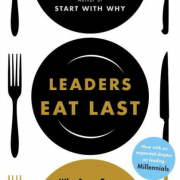
Leaders Eat Last

Why Some Teams Pull Together and Others Don’t
By Simon Sinek


Imagine a world where almost everyone wakes up inspired to go to work, feels trusted and valued during the day, then returns home feeling fulfilled. This is not a crazy, idealized notion. Today, in many successful organizations, great leaders create environments in which people naturally work together to do remarkable things.

In his work with organizations around the world, Simon Sinek noticed that some teams trust each other so deeply that they would literally put their lives on the line for each other. Other teams, no matter what incentives are offered, are doomed to infighting, fragmentation and failure. Why?

The answer became clear during a conversation with a Marine Corps general. “Officers eat last,” he said. Sinek watched as the most junior Marines ate first while the most senior Marines took their place at the back of the line. What’s symbolic in the chow hall is deadly serious on the battlefield: Great leaders sacrifice their own comfort–even their own survival–for the good of those in their care.

Too many workplaces are driven by cynicism, paranoia, and self-interest. But the best ones foster trust and cooperation because their leaders build what Sinek calls a “Circle of Safety” that separates the security inside the team from the challenges outside.

Sinek illustrates his ideas with fascinating true stories that range from the military to big business, from government to investment banking.


Recommendation


Click here to add your own text


Takeaways


Click here to add your own text


Summary


Click here to add your own text


About the Author


Click here to add your own text
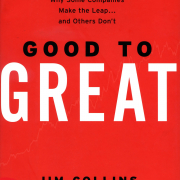
Good to Great

Why Some Companies Make the Leap and Others Don’t
By Jim Collins


The Challenge:
Built to Last, the defining management study of the nineties, showed how great companies triumph over time and how long-term sustained performance can be engineered into the DNA of an enterprise from the very beginning.

But what about the company that is not born with great DNA? How can good companies, mediocre companies, even bad companies achieve enduring greatness?

The Study:
For years, this question preyed on the mind of Jim Collins. Are there companies that defy gravity and convert long-term mediocrity or worse into long-term superiority? And if so, what are the universal distinguishing characteristics that cause a company to go from good to great?

The Standards:
Using tough benchmarks, Collins and his research team identified a set of elite companies that made the leap to great results and sustained those results for at least fifteen years. How great? After the leap, the good-to-great companies generated cumulative stock returns that beat the general stock market by an average of seven times in fifteen years, better than twice the results delivered by a composite index of the world’s greatest companies, including Coca-Cola, Intel, General Electric, and Merck.

The Comparisons:
The research team contrasted the good-to-great companies with a carefully selected set of comparison companies that failed to make the leap from good to great. What was different? Why did one set of companies become truly great performers while the other set remained only good?

Over five years, the team analyzed the histories of all twenty-eight companies in the study. After sifting through mountains of data and thousands of pages of interviews, Collins and his crew discovered the key determinants of greatness — why some companies make the leap and others don’t.

The Findings:
The findings of the Good to Great study will surprise many readers and shed light on virtually every area of management strategy and practice. The findings include:

  • Level 5 Leaders: The research team was shocked to discover the type of leadership required to achieve greatness.
  • The Hedgehog Concept: (Simplicity within the Three Circles): To go from good to great requires transcending the curse of competence.
  • A Culture of Discipline: When you combine a culture of discipline with an ethic of entrepreneurship, you get the magical alchemy of great results. Technology Accelerators: Good-to-great companies think differently about the role of technology.
  • The Flywheel and the Doom Loop: Those who launch radical change programs and wrenching restructurings will almost certainly fail to make the leap.

“Some of the key concepts discerned in the study,” comments Jim Collins, “fly in the face of our modern business culture and will, quite frankly, upset some people.”

Perhaps, but who can afford to ignore these findings?


Recommendation


Click here to add your own text


Takeaways


Click here to add your own text


Summary


Click here to add your own text


About the Author


Click here to add your own text
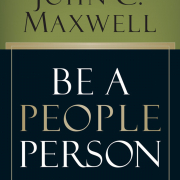
Be a People Person

Effective Leadership Through Effective Relationships
By John Maxwell


Being a leader means working with people, and that’s not always easy! Whether in your office, church, neighborhood, or elsewhere, your interpersonal relationships can make or break you as a leader. That’s why it’s so important to be a “people person” and develop your skills in tapping that most precious of all resources: People.

In this powerful new book, America’s leadership expert John Maxwell helps you:

  • Discover and develop the qualities of an effective “people person”
  • Improve your relationships in every area of life
  • Understand and help difficult people
  • Overcome differences and personality traits that can cause friction
  • Inspire others to excellence and success.

Loaded with life-enriching, life-changing principles for relating positively and powerfully with your family, friends, colleagues, and clients, Be a People Person is certain to help you bring out the best in others-and that’s what effective leadership is all about.


About the Author


Former preacher John C. Maxwell is a leadership expert and the founder of a leadership consulting company. He lectures on leadership principles and is the author of several leadership bestsellers, including 21 Irrefutable Laws of Leadership.

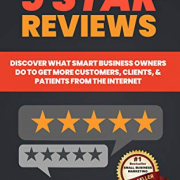
How To Get More 5 Star Reviews

Discover What Smart Business Owners Do to Get More Customers, Clients, & Patients from the Internet
By Mike LeMoine


Do you know that your business is just one review away from having a negative reputation online? This is a scary fact that most business pay no attention to, or try to protect themselves from. The internet created a whole new economy that we call the reputation and relationship economy, and it’s forcing businesses to operate differently.

How To Get More 5 Star Reviews is essential reading for every business owner in the world. This book is going to become your manual on how to ensure your business has a great reputation online and also will teach you how to get more 5-star reviews for your business and then how to market them online effectively.

In this book we cover:

  • Why all the marketing you are currently doing is no longer effective.
  • Why “word of mouth” referrals may be the biggest killer of your business today
  • How to get more 5-star reviews for your business
  • Why all the so-called “experts” are dead wrong when it comes to your marketing
  • How to protect your business from negative online reviews
  • How to market your 5-star reviews for maximum effectiveness
  • How to get more customers, clients, and patients from the internet

This book reveals what smart business owners are doing differently to protect their business from having a negative reputation and what they are doing to get more 5-star reviews online. As a result, these “smart business owners” are benefiting from a steady and continuous flow of leads into their business that is bringing them more customers, clients, and patients on a daily basis.

Most business owners we talk to tell us that they do not feel they are doing as well online as they could be. The reasons are in this book. Most of the so-called “experts” steer you and your business in the wrong direction and the consequences could be disastrous for your business and your wallet.

How To Get More 5 Star Reviews is written by the world’s foremost expert in online marketing for businesses. Fireman Mike LeMoine is a former firefighter and paramedic who has mastered online marketing for businesses and has the results to prove it. His clients dominate in their respective categories with reviews. Mike has helped them get a 5-Star online reputation and then has helped them market it in creative ways online to bring his clients the most ROI possible.

Mike shares all in this new book.

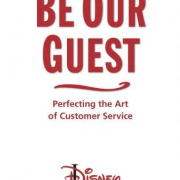
Be Our Guest

Perfecting the Art of Customer Service
By Theodore Kinni


Exceeding expectations rather than simply satisfying them is the cornerstone of the Disney approach to customer service. Now, in honor of the tenth anniversary of the original Be Our Guest, Disney Institute, which specializes in helping professionals see new possibilities through concepts not found in the typical workplace, is revealing even more of the business behind the magic of quality service. During the last twenty-five years, thousands of professionals from more than thirty-five countries and more than forty industries have attended business programs at Disney Institute and learned how to adapt the Disney approach for their own organizations.


About the Author


Ted Kinni has authored thirteen business books. He has ghostwritten seven books for Booz & Company, Prime Resource Group, The Walt Disney Company, LIF Group, and IMPAQ, Inc. He is also an active business journalist, whose articles and book reviews have appeared in a wide variety of periodicals, including cover stories in Harvard Management UpdateAcross the BoardTrainingSelling Power, Quality Digest, and Corporate University Review.

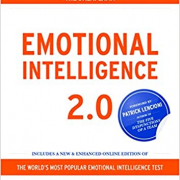
Emotional Intelligence 2.0

By Travis Bradberry


In today’s fast-paced world of competitive workplaces and turbulent economic conditions, each of us is searching for effective tools that can help us to manage, adapt, and strike out ahead of the pack.

By now, emotional intelligence (EQ) needs little introduction—it’s no secret that EQ is critical to your success. But knowing what EQ is and knowing how to use it to improve your life are two very different things.

Emotional Intelligence 2.0 delivers a step-by-step program for increasing your EQ via four, core EQ skills that enable you to achieve your fullest potential:

  1. Self-Awareness
  2. Self-Management
  3. Social Awareness
  4. Relationship Management

Emotional Intelligence 2.0 is a book with a single purpose—increasing your EQ. Here’s what people are saying about it:

Emotional Intelligence 2.0 succinctly explains how to deal with emotions creatively and employ our intelligence in a beneficial way.”
The Dalai Lama

“A fast read with compelling anecdotes and good context in which to understand and improve.”
Newsweek

“Gives abundant, practical findings and insights with emphasis on how to develop EQ. Research shows convincingly that EQ is more important than IQ.”
–Stephen R. Covey, author, The 7 Habits of Highly Effective People

“This book can drastically change the way you think about success…read it twice.”
–Patrick Lencioni, author, The Five Dysfunctions of a Team


About the Author


Dr. Travis Bradberry is the award-winning coauthor of Emotional Intelligence 2.0 and The Seagull Manager and the cofounder of TalentSmart®. His bestselling books have been translated into 25 languages and are available in more than 150 countries.